The Scourge of VAR
In concert with FIFA’s constant meddling with the rules, Video Assistant Refereeing is killing the fan experience. Can it ever be made to work satisfactorily?
The modern game has never been more popular and the Premier League has never been so lucrative yet there is a rising level of disenchantment with top-level football.
In England, over the past decade success and silverware have been consolidated into the hands of a handful of teams. The cost of watching football continues to rise, with fans feeling increasingly that their loyalty is being exploited by the squeeze put on them by the clubs they support and, perhaps for the first time since the explosion in the domestic game’s popularity in the early 1990s, physical attendances (ie the number of bodies through the turnstiles as opposed to tickets sold) could start to decline.
Add in inconvenient kick-off times and short-notice rescheduling of fixtures that take no account of supporters, oppressive regimes “sports washing” their crimes though the hosting of major tournaments and talk of adverts being introduced during drinks breaks at the unnecessarily expanded 48-team World Cup in North America, and the working man’s game has become unrecognisable from its Victorian-era roots.
In terms of the actual match experience, be it inside the stadium or watching on television, nothing seems to be ruining the game more than Video Assistant Referees, an issue that feels as though its reaching a critical mass in terms of fan disgruntlement, complaints from managers and criticism from commentators.
As former player turned pundit, Gregor Robertson, put it in The Times on Friday:
"In the past week it was confirmed that VAR’s scope is to be widened, debate about the latest deeply contentious decisions raged more fiercely than ever, and it was perhaps even possible to detect a subtle shift from the usual state of perma-crisis to something more existential.
"In my view, VAR has greatly complicated decisions concerning handball, fouls and offside. It has multiplied the opportunities for human error. It has added new layers of subjectivity to laws of the game that were never designed to withstand the level of scrutiny imposed by frame-by-frame slow-motion replays."
The impulse for VAR’s introduction in 2019 was born of the era of televised football that began with Sky Sports in the 1990s and the advent of super slow-motion that allowed studio pundits to pore over endless replays of controversial incidents and criticise refereeing standards in the process.
If the technology, through the implementation of an array of cameras inside stadia that could beam footage back to the Premier League’s VAR hub at Stockley Park in West London, could allow for a team of assistant referees to review incidents and come to a “correct” decision in accordance with the current football laws, perhaps the most egregious human errors could be ironed out for the good of Premier League football.
For the ordinary fan, particularly those of teams outside of the old “Sky Four” and current “Big Six”, the hope was that some of the bias — conscious or otherwise — that seemed to favour the uber-wealthy, media-darling clubs might also be addressed by having more eyes on the matches and a dispassionate perspective away from the heat of the action on the pitch.
Sadly, in terms of perceived bias and inconsistency, VAR has merely intensified criticism of the match officials and the “mission creep” of the video referees’ remit, aided by Professional Game Match Limited (PGMOL, the body that oversees officiating of matches in English football) and the way in which they assess their referees’ performance, has led to an unbearable level of intrusion and length of scrutiny of many incidents during matches.
Referees, like offside and the many other rules that have been added over the past 160-odd years, were introduced to ensure a basic level of agreed fairness and consistency to what might otherwise have been anarchy. The sport was never designed to have every potential incident forensically scrutinised in slow motion and while the modern game is faster-paced than ever before, it is also being suffocated at the top level by ever-changing rules, an obsession with trying to reach the “right” decision at every turn and, as a result, the scourge of VAR.
Subjectivity, Delay and Confusion
The problems with Video Assistant Refereeing and the way it has been implemented in Europe’s top five leagues are numerous. Whereas goal-line technology, strictly a separate innovation in that it uses the Hawkeye system and sends signals directly to the on-pitch referee as opposed to relying on video replays, has been an unquestioned success and there was a hope that semi-automated offsides might achieve a similar level of accuracy (depending on how black-and-white the parameters are), many of the other myriad decisions that are required during the average match are inherently subjective.
The situation is not helped in any way by the succession of rule changes and adaptations being handed down by the International Football Association Board (IFAB), particularly in recent years concerning handball. They have led to confusion and disagreement over, for example, what constitutes deliberate handball or what constitutes sufficient force and intent for a challenge worthy of a red card for serious foul play.
How can a system brought in to try and ensure that every decision is right according to the letter of the law work when each incident is subject to the interpretation of the beholder? Not surprisingly, we’re having to live with maddening inconsistency when you would think that one incident — Michael Keane’s dismissal for hair-pulling or Jake O'Brien's disallowed goal at Aston Villa for Harrison Armstrong's supposed interference come to mind — should set the precedent to be followed for the next.
Then there is the time the review processes take while supporters inside the ground have to sit or stand around waiting, often not knowing the specifics of what is being looked at. And even once the official has announced his decision over the tannoy, the attending fans have no context. The argument has been made that television companies love the drama of VAR but for a sport that is always moving and is supposed to have as few stoppages as possible, it makes for an awful spectacle even on screen.
VAR is far too forensic and far too intrusive. Matches are being re-refereed from Stockley Park with the main on-field official stripped of his ability to apply common sense or a nuanced application of the laws according to the temperature and character of the match he is over-seeing.
But the most unforgivable by-product of VAR and far and away the biggest argument for scrapping it immediately is that it has killed the simple, spontaneous joy of celebrating a goal. Unless the ball has been banged in from 30 yards — even then you don’t know if a player was potentially blocking the goalkeeper’s view from what might then be deemed an offside position — your elation at seeing you team score is immediately cut short by the dread of knowing VAR will review the footage looking for any reason to chalk it off.
PGMOL head, Howard Webb, together with another former referee responsible for the roll-out of VAR, Chris Foy, recently undertook a fact-finding mission to various parts of the country to gauge the mood among match-going fans around the state of refereeing in the Premier League.
According to the A View From the Bullens podcast they were shocked and saddened to hear from one supporter that they just don’t celebrate goals anymore. Whether that spurs a concerted effort to scale back VAR’s reach remains to be seen but until the top flight clubs themselves drop their support for the system, it’s almost certain to remain in place.
Can VAR be fixed?
When the question of retaining VAR or scrapping it last came up for a vote, Premier League clubs voted 19-1 to keep it in place, Wolves being the only ones against it. There is widespread support for the process in the hierarchies of the member clubs, often either echoed or influenced by the managers.
Though the tide certainly seems to be turning against VAR and the calls from hardline opponents to scrap the system for everything except the goal-line technology are growing louder, it would take a tsunami of discontent to wash it away. And the recent cup tie between Aston Villa and Newcastle where referee Chris Kavanagh and his assistants had a nightmare in the absence of back-up from Stockley Park served as a strong argument for why VAR is needed.
With that in mind, could Video Assistant Refereeing be reformed or significantly scaled back and what might that look like?
Reforming Offside for Good
Few issues cause more consternation among football fans than goals being chalked off for marginal offside. Offside is an issue that has preoccupied IFAB for years and though the change to the law to “level is onside” after the 1990 World Cup was a welcome and positive one, VAR’s introduction has made the issue far more black and white than was ever intended when the original laws were drafted back in 1863.
In the obsession to come to the "correct" decision, VAR initially began measuring offside by hairs-breadth margins of lines drawn on an arbitrary video frame determined by the passing player’s first contact with the ball. The speed of modern football made that a somewhat farcical notion — at 24 frames per second, who’s to say they chose the right one? — and those fine margins were deemed by many to be overly stringent. So, in the 2020/21 season, a 5cm tolerance was introduced.
The fact that tight offside calls continue to be decried and lambasted by fans, managers and pundits alike as being contrary to the spirit of the laws shows that that 5cm tolerance is still far too small. One solution would be to either widen the tolerance significantly to, say, 20cm to 30cm. Or by padding the initial 1cm lines drawn against the defender and the attacker by a similar distance and mandating that if there is any "daylight" between the two lines, it is offside; any overlap and it's onside.

Fig. 1: Under the current implementation of VAR and semi-automated offside (when used) in the Premier League, a small 5cm tolerance (the white zone) is used but not effectively communicated in the screen graphics shown to viewers.

Fig. 2: A potential solution is to significantly wider the tolerance by four to five times (the wider the white zone here). When the lines are removed, it's clear between Fig. 1 and Fig. 2 above which incident could acceptably be determined as offside and which feels in violation of the spirit of the original law.
Rather than widen the tolerance however, FIFA will soon begin trials in Canada of the so-called “Wenger Rule” which proposes that a player is onside if any part of their body is in line with the last defender.
While this may sound fine in theory, it would have serious ramifications for the art of defending and might sweep away overnight the deployment of the offside trap as a tactic. In certain circumstances, the distance between one defender’s foot and an attacker’s front foot could be as much as six feet.
In this image from Sky Sports, Harry Kane (in white) is offside by any sensible interpretation of the rules but the overlap between his trailing foot and the defender’s would keep him onside under the Wenger Rule.

Far better would be to restrict the active zone for offside to the players' torsos or, perhaps, from the bottom of the shorts to the armpit and measure from there. In the following graphic from the semi-automated offside system, the attacker (in red and clearly level) would be deemed to be offside under the current rules due to the position of his knee. However, with only torsos measured and with a generous 30cm tolerance, this would be an onside decision and, again, very much within the spirit of the laws.

Hand Power Back to the On-pitch Officials
If it feels very much as though the tail in Stockley Park is now wagging the dog inside the stadium, one welcome move would be to significantly raise the bar for what requires intervention by the Video Assistant Referee. This was promised by Webb but, if anything, VAR feels more intrusive, fussy and inconsistent than ever; as if only the people forensically analysing replays in a booth could possibly reach the right conclusions.
As one observer put it this past weekend, VAR was only supposed to be needed for the moments that made you say, "Crikey, that's a poor decision!" In other words, clear and very obvious errors. The most extreme examples would, of course, be Maradona's "hand of God" goal in the 1986 World Cup or Thierry Henry's handball against the Republic of Ireland, both hugely significant incidents in the context of the matches in which they occurred and which would have been caught by video replays had they been available to the officials at the time.
More recently, referee Kavanagh missing the fact that during the afore-mentioned cup tie, Lucas Digne had handled the ball a yard inside Newcastle's penalty area and not outside the box would be another egregious oversight that would certainly have been corrected by VAR.
Of course, just because VAR is there, doesn't mean that the right decision will be reached. In the incident involving Rodri at Goodison Park in March 2022 where the ball visibly hit his arm below the sleeve but neither the referee nor the VAR saw fit to award Everton a penalty, the argument for the existence of VAR felt hollow. By the same token, in the clash between Manchester United and Crystal Palace the weekend before last, not only did VAR, Tony Harrington, not reverse the award by Kavanagh — yes, him again — of a penalty despite a clear dive by Mateus Cunha, he doubled down by recommending that Maxence Lacroix be sent off for denial of a goalscoring opportunity as well.
But restoring the responsibility for all bar the most obviously controversial incidents to the primary match official on the day and mandating that VAR reviews can only be instigated by the referee would reduce the growing distrust in the decrees coming from Stockley Park. It might also lessen the reliance on super slow-motion replays which, particularly where the interpretation of "serious foul play" is concerned, can warp the perception of the intent and severity of a particular tackle.
Furthermore, a review by PGMOL of their grading system of referees to encourage common sense application of the law and to not penalise officials for going against the VAR's recommendation regarding a given incient would be a another hugely welcome development.
More Radical Suggestions
In addition to the trials of the Wenger Rule and the possible introduction of 60-second time limits for VAR reviews, FIFA may yet experiment with the suggestion that, like in tennis and, to a degree, the NFL and baseball, head coaches be given a set number of challenges per match that would trigger a video review.
That obviously leaves open the opportunity for controversy in a particularly contentious match where a given manager has used his two challenges only for an obviously incorrect decision to crop up late in the game that would then go uncorrected.
In that instance, like in American Football, a booth review could be initiated by the VAR but the bar would have to be set very high for such an intervention.
Then there is the idea of adding two more assistant referees to the touchline, one for each quadrant the pitch, to cover more of the primary referee's blindspots and put more eyes on the action to spot infringements and infractions.
Finally, the elimination from slow-motion replays should be trialled given that in Daisy Christodoulou’s book, I Can’t Stop Thinking About VAR, referenced by The Times article she explains that studies show that actions are more likely to be perceived as intentional in slo-mo than when viewed in real time.
Is it worth it?
When supporters of clubs threatened by relegation (particularly those who only recently came up from the Championship) find solace in the prospect of a season free of the scourge of VAR when they go back down, you know you have a problem. Likewise, if those, like Wrexham, who might yet find themselves in the top flight next season are already bracing themselves for the misery of aborted goal celebrations and endless controversy having got their first experience of it in the FA Cup.
That hankering for just being able to erupt in joy at a goal following a cursory glance towards the linesman in case of an offside flag is enough to make you want to simply throw VAR in the bin and go back to the way it was. Human error was the initial justification for VAR but it feels as though rather than clarify the decision-making aspect of top-flight refereeing we have merely layered on more subjectivity and confusion to what is already a fiendishly difficult job and one that is impossible to get right all of the time.
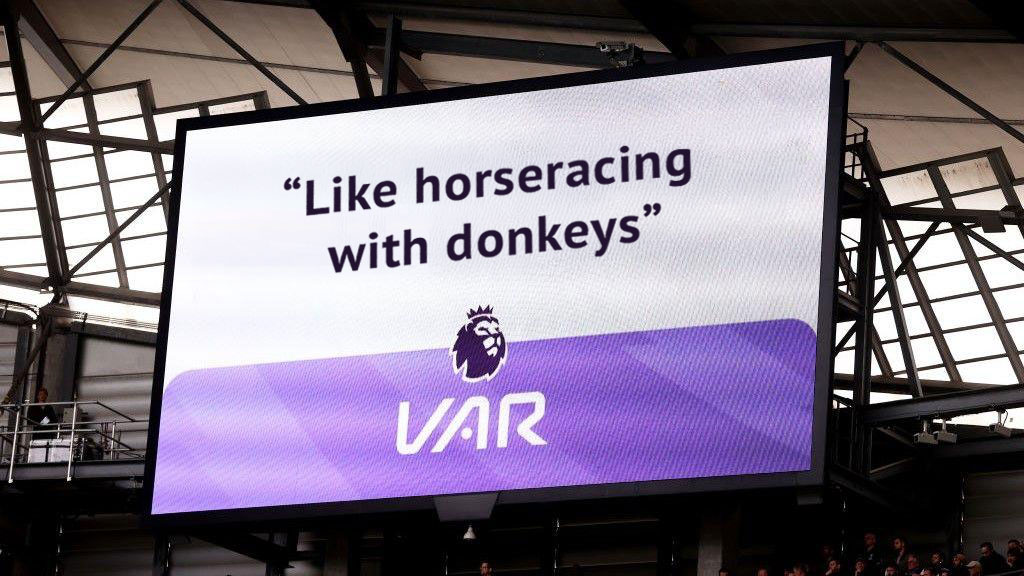
Fans are starting to voice their displeasure. Last month, Augsburg supporters filled their stand with anti-VAR banners, including one that said: “Football with VAR is like horseracing with donkeys”. In a Bundesliga 2 match between Munster and Hertha Berlin just this weekend, supporters held up a sign reading “Pull the plug on VAR” and two home fans did just that, jumping out of the stands with one of them disconnecting a VAR cable.
After a problem with semi-automated offside during Barcelona’s Copa del Rey match against Atletico Madrid last month prompted an eight-minute review before Pau Cubarsí's goal was chalked off for what Gregor Robertson described in the article linked above as "the kind of absurd offside decision that did not exist pre-VAR," Hansi Flick lamented: “For me, it’s a mess. It’s so bad here.”
Borussia Dortmund manager, Niko Kovac, said recently: “The biggest problem is there’s no common denominator. Whoever is sitting in the [VAR] studio or whoever is refereeing has a different perception. One week you’re annoyed that something wasn’t called. The next week it’s decided differently and nobody understands the world any more.”
Would more managers, pundits and perhaps players call for VAR to be scrapped and would that clamour turn the opinion of the clubs? For now, there doesn't appear to be much chance of that.
A Premier League executive said recently that, “We have to have VAR. The game’s moved on so much, it’s played at such a high speed and tempo. It’s right that we have VAR to help the referees".
Meanwhile, Newcastle boss, echoing sentiments expressed by the likes of former Burnley, Everton and Nottingham Forest boss, Sean Dyche, in saying: “I’m so torn because the game is better without VAR, in terms of excitement and the spectacle for the supporters and us when we’re living a moment live. But it does give accurate results. It does make the game more precise in terms of decision-making. You have to respect those moments. They’re worth their weight in gold.”
What's worth even more, though, is the unmatched feeling of your team scoring a last-minute winner free of the nagging fear that that priceless goal might get taken away after some over-officious screen jockey has pored over the previous 30 seconds of footage looking for an infringement.
Until or unless that prospect of reflex, forensic review is removed and fans can feel confident that if the on-pitch ref hasn't seen anything significant, a goal will probably stand, the trade-offs for aiming to reach the "right" decisions with VAR just aren't worth it.
Addendum — Margins with regard to offside
(Added 9 March, 2026)
Following some discussions on social media, I thought it would be worth addressing a point that keeps coming up with regard to the idea of adding greater tolerance or thicker lines when measuring offside with VAR.
The argument thrown back is that no matter how wide you make the tolerance, there will always be marginal offside decisions. As one ornery kopite replied on X/Twitter: "They could make the line 30cm thick it wouldn’t make a difference. You will ALWAYS get tight calls. You can make the line as thick as you want, the number of tight decisions will be exactly the same."
To follow this example, yes, a player measured to be 1cm beyond a 30cm tolerance could be regarded as being 1cm offside under this interpretation. That is a tight call if you're only thinking about that 1cm but it doesn't take into account the leeway afforded by the tolerance. In actual fact, the player would be 31cm offside (when the tolerance is taken into account) from where measurements were taken when VAR was first introduced in 2019.
(As an analogy, many banks offer an overdraft facility allowing you to go, say, £200 below zero to give you time to add funds to the account. Go even a penny over and you get penalised. It may be the tiny margin of a penny but it's 20,001 pennies past the original limit. In the same way that banks offer that grace leeway, adding tolerance to offside would help keep it within the spirit of the laws as they were first drawn up in the 19th Century to prevent goalhanging.)
In other words, it's all in how you look at such a proposed change to how VAR measures offside or how it is framed in the communication from IFAB, UEFA or PGMOL and the Premier League. Players would be allowed to be more offside than they are under the current 5cm tolerance so as to avoid them being ruled "offside by a toenail".
Looking at the right-hand panes of Figs. 1 and 2 above, in each scenario the player is offside according to the respective tolerance used but it's easy to see which actually looks off under any sane interpretation of the original laws.
Reader Responses
Selected thoughts from readers09/03/2026 11:19:23
A great article Lyndon. Your headline sums up the feelings of the vast majority of match going fans. I was never convinced VAR should be used for subjective decisions. From the outset there has been an obvious clash of opinion between fans and the professionals, especially managers and referees. The professionals care less about entertainment than they do about the pursuit of correct decisions. After seven years of operation we are as far away as ever from achieving the consistency the professionals say they desire. Indeed we have arguably more precisely incorrect decisions than ever.
The argument that VAR works well in Europe has been shown to be false. Recent feedback has confirmed it doesn’t and that fans are disenchanted with the whole system. The suggestion that the problem lies not with the system but with those operating it gets us nowhere. They have had seven years and counting to get it right. Each attempt to improve the system, each attempt to raise the bar for intervention has arguably increased the confusion and inconsistency.
I think the time has arrived for fan groups, including FABs to push Premier League club executives to scrap the system other than for goal line decisions. It was staggering that nineteen clubs, presumably heavily influenced by their ‘here today, gone tomorrow managers’ saw fit to vote for VAR retention. At best that vote demonstrated how out of touch they are with their fans. At worst it demonstrated how little they care for the fans’ views or the game as a spectacle.
09/03/2026 12:54:55
We all complained about referee’s decisions before VAR, but nobody imagined we would end up with what we have now. It has ruined the game. Get rid of VAR. You win some, you lose some. That is the way of the world.
09/03/2026 13:49:21
There is not a football fan, player or manager, in fact anyone who loves the game of football, who wanted to see Coventry's winner in the FA cup semi v Man United, or Burnleys goal against Brentford, or Wrexham's goal at the weekend, or many more I could mention, ruled out for toes, patellas or funny bones being offside. Show the replay at normal speed and give the goal, in the spirit of the game and for the joyful moments of the game we used to love.
Surely even refs can see obvious offsides at normal speed and call them right, or allow the goal if not obviously offside by a distance. Can't they? Are they really that bad? How have we allowed it to get to this? Without var refs make mistakes, but everyone does and we get on with the game. They are destroying the game with their miserable efficiency. Not many want this scrutiny in the game now and something needs to be done, and the next time it happens to us at Hill Dickinson I am walking out, I can't take my matchday being ruined by joyless forensic nit pickers any more.
09/03/2026 14:37:13
It's much worse I think than we want to contemplate. This thing is all about the framing. Most of us imagine VAR was introduced to bring greater accuracy to football, and clear up controversial decisions, it was an attempt to make things just about perfect.
From the very start, that's what it was sold as.
But as usual, the bastards are lying to us. VAR was introduced, to maximise controversy, to make the game semi interesting to people who wouldn't normally follow football, but who now will cos of the shenanigans which go on whilst a decision is being debated. For the neutral, football is getting more interesting, just cos there are these investigations, everyone waits for the decision, and then there is an hour long discussion about it. F
or the people who own footy, none of this is a problem, in fact, it's the point. They WANT the controversy, They want the clicks. the Debate. And the actual game can now be manipulated by god knows who, sat in a booth, miles away. And if the real fans don't like it, are our new financial overlords going to care? I think there attitude will increasingly be 'if you don't like it, there's the door'.
09/03/2026 15:03:13
Absolutely spot on as usual Lyndon.
Premiership football is being destroyed in 6 letters - SKY and VAR.
I love cricket and when teams appeal a not out or whatever the process is pretty quick, shown to everyone and the options are few and understandable.
I appreciate the game is slower but they still make decisions quicker than VAR.
I enjoy watching Marine where the game is played (mostly) in the right spirit and if a goal is scored, a goal is scored.
Let’s scrap VAR and enjoy celebrating goals again, but I won’t hold my breath.
09/03/2026 16:01:20
The argument for technology to intervene found its cause célèbre, in England at least, with Frank Lampard's disallowed goal against Germany in the 2010 World Cup.
That incident was two clear feet over the line on the biggest stage in the world, making demands understandable.
Fast forward 16 years and we're now pausing the game for 5 minutes to determine the severity of centre-circle fouls in low-stake, mid-table clashes where no clear and obvious error has been spotted in real time by anyone in the stadium.
VAR replays are well-and-truly stitched into the TV viewers expectations and it would be difficult to put that genie back in the bottle.
Managers' tenures would be shorter still if they had to regularly account for an imperfect 'two challenge' record with 50,000 experts baying for his blood.
A 60 seconds time limit still breaks the flow of the game, for me, and leaves match-going fans too long in the dark.
I quite like the idea of scrapping match day VAR and adding two extra assistant referees as it's the least intervention on the current game and more eyes on the incident. Worth an experiment at least.
Then, if required, on Sunday nights, have a Sky highlights programme with all the VAR you like. Slo-mo fans get their hit. Viewers can scream at their injustices at the TV but with no affect on the flow or result. Hugely problematic, of course, but the return of the instantaneous cheer or groan is worth it.
10/03/2026 07:12:49
Lyndon’s wonderful prose deserves a more elegant response than a simple ruffian’s rant of, ‘Get Rid’, but that is the bottom line.
In the Palace v Spurs game last week, a Palace goal was given offside because the player’s nose was deemed to be offside. This is absurd. The original footballing rule makers never intended such a microscopic interpretation. It was purely to stop goal hanging.
Not one fan of any club I know supports it. It’s criticised every week by managers, pundits and supporters. We hate it because we know it doesn’t work. We support Hawkeye because it does work. Simple.
Despite some arguing that VAR decisions favour the top clubs, the data doesn’t back that up. VAR is simply bad for every club. Why only one Premier league club supported to keep it last season baffles me.
So get rid, get rid, get rid before it completely strangles the life out of our game.
10/03/2026 09:29:45
Ruffian here – get rid.
I loved the FA Cup growing up; there was something special, electric, about those games. Yet now even this institution is being ruined by VAR. The Wrexham-Chelsea game was one of those magical games, at least it should have been. The reason why it wasn't? Well...
10/03/2026 09:56:16
Personally I would prefer the broader tolerance, say 20cm for each line and any overlap gives the benefit to the striker. I would also only measure the position of the players feet to check for offside
10/03/2026 10:18:09
“How many angels can dance on the head of a pin?” was surely an easier philosophical discussion than “what now constitutes an infringement of the laws of the game of football?”.
10/03/2026 17:32:55
Excellent articles on crucial topics, such as Lyndon's latest oeuvre, are rare & precious.
They should become, rightly reference points for future debates.
VAR is a probably fixture as abandoning it or introducing some radical & nonsensical alternative would be lunacy; sensors embedded in the turf anyone?
Thus to refine it sensibly, always with the benefit tilted towards the striker, is the best we can hope for.
I like the idea of a buffer zone; 30cm is one foot & ideal.
Figure 2 embedded in the text illustrated it perfectly.
Otherwise for our team, only sign players with small feet, short hair and noses with all fingernails well trimmed.
10/03/2026 20:20:13
I’ve just watched a little bit of the Liverpool game and when Galatasary, scored a goal it was ruled out for offside even though the player never touched the ball.
I hate VAR, I genuinely think it is ruining the game, I genuinely think it is at times very inconsistent, and this was definitely the case tonight because surely a VAR check, should have overruled the offside decision and given the goal?
They say VAR is not going away but with the way it is currently being used then I’m absolutely certain that it’s going to slowly drive a lot of people away from watching football.
11/03/2026 01:02:23
A great article which should be shoved under the noses of every football executive in the world.
Before it is though, you might need to change that to *20,001 Pennies" Lyndon :-)
11/03/2026 06:58:52
Absolutely stunning article this guy Lyndon writes much more elequently than most of the football sports writers from the broad sheets I really enjoy reading his articles he has both the touch of the common man or woman that is an ardent football supporter and also we great technical knowledge of the overall game including the hierarchy of the game brilliant article.
11/03/2026 11:58:12
As far as I'm concerned, if VAR wasn't around for the 1977 FA Cup semi-final, its introduction was too f***ing late.
11/03/2026 13:16:32
It'd make no difference, Mike. Thomas was so arrogant that he'd be unlikely to venture to the monitor to review the footage, let alone consider changing his original decision.
11/03/2026 20:14:32
Thanks, Jamie! Good grief, what an error. A cautionary tale about adding bits to your article while watching telly at the same time!
11/03/2026 22:04:12
I am genuinely torn on VAR. I've only been to one game live and didn't find it that challenging as a spectator... we celebrated a goal that was chalked off and it didn't worry me too much. I was still jumping about:) I actually think the offside is the least controversial... pick a line and stick with it. Then tell the pundits to STFU about it - that is what generally causes most of the outrage. It would help if the pundits/co comms actually knew the rules too. They should be forced to do a refs course of some sort. If they fail they don't go on air:)
My main issue is with stuff that is open to interpretation...like interference or foul play. The ref should be the final arbiter in all scenarios. If they view it and change their mind so be it. If it is an interpretation scenario then it has to still be the onfield refs decision. They used to do a version of this by overruling a linesman if they thought it wasn't correct
12/03/2026 10:15:28
Very comprehensive article Lyndon, but the whole issue of VAR falls apart when it is subject to subjectivity, another officials opinion. Conversley The issue of offside has been totally wrecked by the application of idiocy. Tolerances are merely making a straight forward review even more complex but if that's the way then it should be made clear on which part of the anatomy you are measuring!
For me I would like to see the following:
1. Offsides. For a player to be offside there has to be clear daylight between defender and any part of the attacker. For further clarity if the gap is less than 5cm the player is judges to be onside. This is to give frame tolerance to the actual moment the ball is played. A video frame out and the distance between defender and attacker changes. Eliminate subjectivity.
2. Handball. Accidental handball should not constitute a penalty. Ball striking arm is exactly that. Ball impeding arm is a penalty. Accidental handball leading up to or in scoring is not foul play.
3. VAR reviews of goal should only be at the request of the referee. No goal should be disallowed if an incident occurred several plays earlier or linesman did not flag. A goal is a goal.
4. VAR should make the referee aware of any infringement irrespective where if an official has missed it.
5. Right of Captains Appeal. Where there is a dispute over a decision not addressed by VAR, a captain has 2 opportunities to request a review and why with the referee.
VAR and it's use should be limited not expanded.
13/03/2026 23:07:53
I normally agree with Christine but I really don't with the offside line. Daylight would likely lead to defenders not risking playing offside anymore and a fundamental change to the game.The prospect of someone being a toenail onside when the rest is offside seems just as bizarre to me. I am a big fan of the captains call though...1 per half. That way the players would only appeal something they are sure of... in cricket it works well as the players know what has happened most of the time.Otherwise leave it to the onfield ref to request a review and the VAR to pick up serious foul play that has been missed.
17/03/2026 21:15:45
Thanks Lyndon for yet another fantastic read.
Regarding offside, I’ve often wondered whether these stats vests the players all wear could be utilised. Why not stitch in a sensor that forms a definitive record of where that player is in space? Surely that would lead to far less subjectivity… if the sensors say he’s off, he’s off.
Add Your Thoughts
Only registered users of Evertonia can participate in discussions.
Or Join as Evertonia Member — it takes just a few minutes and will allow you to post your thoughts on artices across the site.
22 Comments ↓