Everton in the Premier League
1992-1997: Lows Punctuated By a Europhic High
As one of its joint architects and members of English football's “Big Five”, Everton were still pioneers of the domestic game when the Premier League — or Premiership, as it was known then — began in 1992. As such, they should have been ideally placed to capitalise on the riches and foreign talent that would flow into the top flight in the years that would follow.
Instead, the former Mersey Millionaires and two-time League Champions in the 1980s would be beset by complacency and mis-management that would lead to two close calls with relegation during the 1990s that would bookend a brief period of hope when Joe Royle guided the Toffees to FA Cup glory and hamper magnate, Peter Johnson sparked unprecedented — but short-lived — investment in the team.
The First Great Escape
The financial problems that would hamper Everton in the first half of the 1990s were already in evidence when the inaugural Premier League season kicked off in 1992/93. The Club had operated at a £2m loss the season before, a not insignificant sum at the time, and Howard Kendall, who had re-joined the Toffees for the second of three stints as manager in November 1990, had been forced to leverage some of the bargain recruitment acumen that had brought in the likes of Andy Gray and Peter Reid for relative peanuts in the 1980s.
Barry Horne was signed from Southampton, Paul Rideout arrived from Rangers, and Paul Holmes was bought in March 1993 from Birmingham City for combined fees of less than £1.5m. Defender Martin Keown was sold to Arsenal for £2m to balance the books and at the start of the season, Pat Nevin left for Tranmere for £250,000.
Nevertheless, the new campaign started brightly. The Blues recorded a handsome 3-0 away win over eventual champions Manchester United while the new "millionaires" of Blackburn were beaten 3-2 away and there was a Goodison derby triumph to savour as Peter Beardsley became only the second player to have scored for both teams in all-Merseyside matches.
Later in the campaign, a thumping 5-2 win at Manchester City's Maine Road demonstrated how good the team could be when it was firing on all cylinders but those moments were fleeting in what was a disappointing season overall. Everton were struggling in the wrong half of the table around the turn of the year and eventually finished in 12th place, four points above Crystal Palace who were demoted to the First Division along with Middlesbrough and Nottingham Forest.
If Kendall could be lauded for many of his incoming signings, he wasn't immune to errors and even at the time, the decision to sell Beardsley to Newcastle United for £1.5m in the summer of 1993 felt like a curious move, although the manager might well have had one eye on finances. Indeed, the only acquisition during the close season that year was Graham Stuart who arrived from Chelsea for £850,000 but he would prove his worth in his weight in gold by the end of 1993/94.
Kendall would be gone by then, the Goodison great reportedly resigning in December when he was denied the £1.5m he needed from the board of directors to sign striker Dion Dublin from Coventry City, but not before he had overseen an encouraging start with three consecutive wins.
Victory again in the Merseyside derby lifted spirits after three straight losses but a 5-1 hammering at home to Norwich revealed that all was not rosy in the garden and the Blues' inconsistent form continued until Kendall departed after a 1-0 home win over Southampton. Reserve-team manager Jimmy Gabriel took over interim head-coaching duties while Everton conducted a search for a new manager which eventually ended in January with the appointment of flavour of the month, Mike Walker.
The "Silver Fox" had worked wonders at Norwich City, taking the unfanied Canaries into Europe and beating German giants Bayern Munich once they got there, and he had been identified as the man to bring glory back to Goodison. Gabriel had taken charge of seven games in all and lost six of them but Walker's debut game was a hugely positive one as Everton smashed Swindon Town 6-2.
It didn't last, however. Defeat to Bolton in an FA Cup replay and a loss to Manchester United at Old Trafford was followed by a brief revival that saw wins over Chelsea and Oldham and draws against Arsenal and Ipswich before a run of just one victory in 10 games dragged the Club into the bottom three and a nail-biting final day clash with Wimbledon.
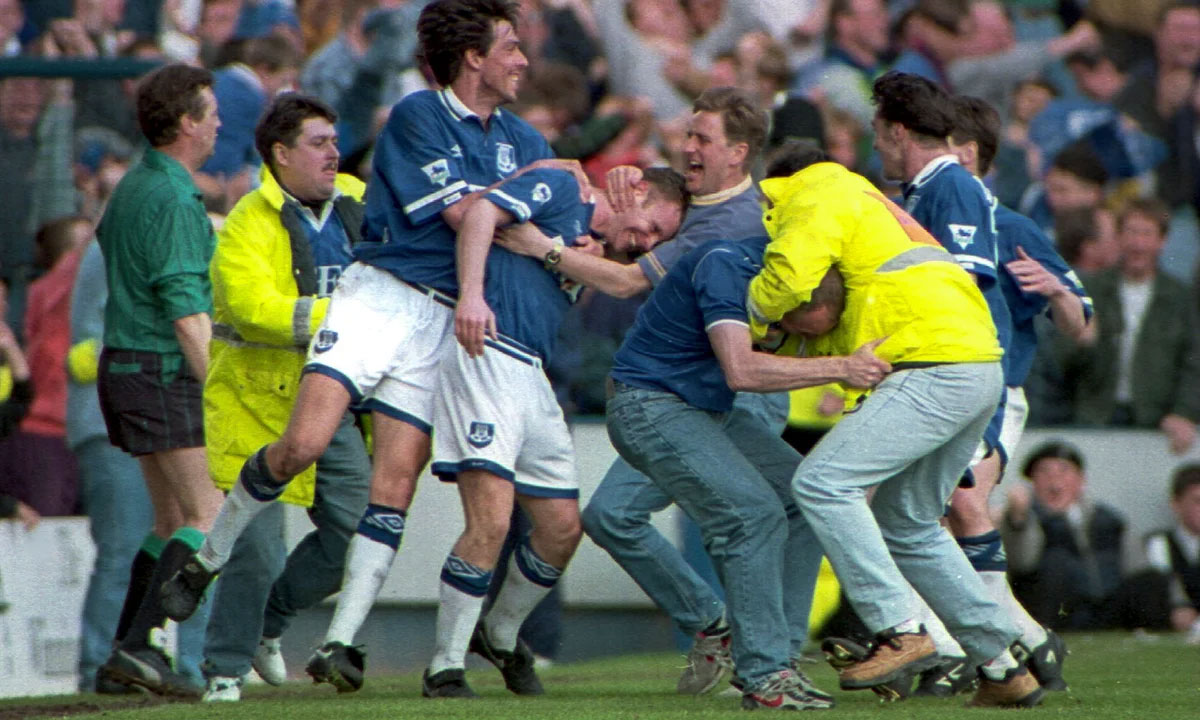
Needing a win to have hope of staying up but 2-0 down after just 20 minutes, Everton were heading for their first relegation to the second tier for 53 years before a Stuart penalty on the stroke of half-time earned them a penalty that halved the Dons' lead. A goal from Barry Horne that was as spectacular as it was rare and unexpected levelled the match at 2-2 which set the stage for Stuart to bobble Tony Cottee's lay-off over the hands of goalkeeper Hans Segars to send Goodison Park and those fans balanced on the branches of trees in Stanley Park, straining for a view through the construction in the Park End, into ecstacy.
A Royle Succession Leads to Wembley Glory
With local Park Foods millionaire, Peter Johnson, having taken over the Club earlier in 1994 with promises of investment in the side and an ability to compete with the biggest teams in the division in the transfer market, the feeling was that Everton had successfully dodged a bullet with that close call with relegation and could start building for a new era. Mike Walker was backed that summer with the signings of Vinny Samways from Tottenham for £2.2m and he was followed by one of the standout performers for Nigeria in the USA World Cup, Daniel Amokachi, who was drafted in from FC Brugge for a new club record £3m fee.
The heady optimism was short-lived, however, with Walker unable to avoid the horrendous form that had put the Blues into jeopardy at the tail end of the previous season. The manager failed to win any of his first 12 Premiership matches and with Everton rooted to the bottom of the table, he was summarily sacked, ironically after he'd finally overseen a victory, a slender 1-0 win over West Ham.
For his replacement, Johnson turned to a Toffees legend in the form of Joe Royle who took the helm in November with none other than Liverpool looming as his first opponents in the Goodison derby. A top-class centre-forward in his playing days, Royle immediately saw the raw potential in Duncan Ferguson, the towering, combustible Scot who had been signed on loan from Glasgow Rangers the previous month but who had yet to make an impact.
Not for the first time in his time with Everton, Ferguson rose to the big occasion, figuratively and literally. Leaping above the Reds' defence to meet Andy Hinchcliffe's superb corner, the 6' 4" striker powered home an emphatic header to put the home side ahead. In the second half, Rideout would swivel home a second to make the game safe, handing Royle a dream start and a hero's return to his spiritual home.
Two more wins followed, against Leeds United and at Chelsea, with Royle taking the run of games without conceding to a club-record seven, under-pinned by a defence marshalled by skipper Dave Watson and bolstered by David Unsworth and a tenacious midfield of Barry Horne and Joe Parkingson that, as a collective, he off-handedly dubbed his “Dogs of War”, an epiphet that stuck and came to define his brief but successful tenure.
That gritty core would prove to be vital as Royle eventually led the Blues to safety that season. Important home wins against the likes of Crystal Palace, Manchester United, Norwich City and Newcastle buouyed the team but away results ensured that it was a grind that didn't see the Club safe until the penultimate match of the campaign when a seven-match unbeaten run banished the threat of more final-day drama.
Off the pitch, Johnson was delivering on his promise to modernise an instituion that had been stuck in the past for too long, restoring the Prince Rupert's tower on Everton Brow, commissioning a new club shop on the corner of Walton and Spellow Lanes, and launching both The Evertonian magazine and Radio Everton. On top of that, a club record £4.4m deal was reached with Rangers to make Ferguson's move south permanent.
All the while a fairytale unfolded in the FA Cup. The style of play that season was rarely School of Science fare but Everton were no longer the push-overs they had been under Walker. Nevertheless, they could still be explosive when the mood took them, as they proved on a cup run that began modestly with narrow wins over Derby and especially at Bristol City before Norwich were despatched 5-0 at Goodison.
A Watson header was enough to overcome Kevin Keegan's Newcastle at Goodison in the Quarter-Finals which set up a date with much-fancied Tottenham at Elland Road in the last four, a game that the had captured the national media's attention in anticipation of a Wembley showpiece final between Spurs and Manchester United. Royle and Everton had other ideas, putting on one of the most memorable performances by a Toffees side in history, one that belied their lowly league position and which blew Jurgen Klinsmann and the North Londoners away.
Matt Jackson, scorer of the winner in Bristol in the Fourth Round, glanced home one of Hinchcliffe's trademark corners to make it 1-0 and Stuart rammed home a second after Mike Walker's son, Ian, in the Tottenham goal had saved the intial shot. Klinsmann pulled one back for Spurs to give them hope and when Rideout pulled up injured, there was a fear that the momentum might be shifting towards the Capital.
Enter Daniel Amokachi and a moment that went down in Everton folklore when he introduced himself as Rideout's replacement before any of the coaching staff had realised what had happened. Within minutes, the bustling forward had headed home to restore Everton's two-goal lead and then wrapped up the rout by belting Gary Ablett's centre into the roof of the net.
And so to Wembley in May and the Final against the media darlings, United. Everton were undisputed underdogs but when Anders Limpar sprinted away down the left on the counter-attack and crossed for Stuart, the former Chelsea man thought he had put the Blues ahead but his shot crashed back off the crossbar. Thankfully, Rideout was on hand to meet the rebound with a leap above Steve Bruce and he nodded home to make it 1-0.
Then it was a case of one of those rearguard actions that Royle and his players had honed over a determined battle to beat the drop, with the defence holding firm in front of a rolling-back-the-years display Neville Southall, particuarly in the second half before the referee called time and Watson lifted the FA Cup for the fifth time in Everton's history, capping a remarkable season.
Sky-High Expectations Lead Back to the Doldrums
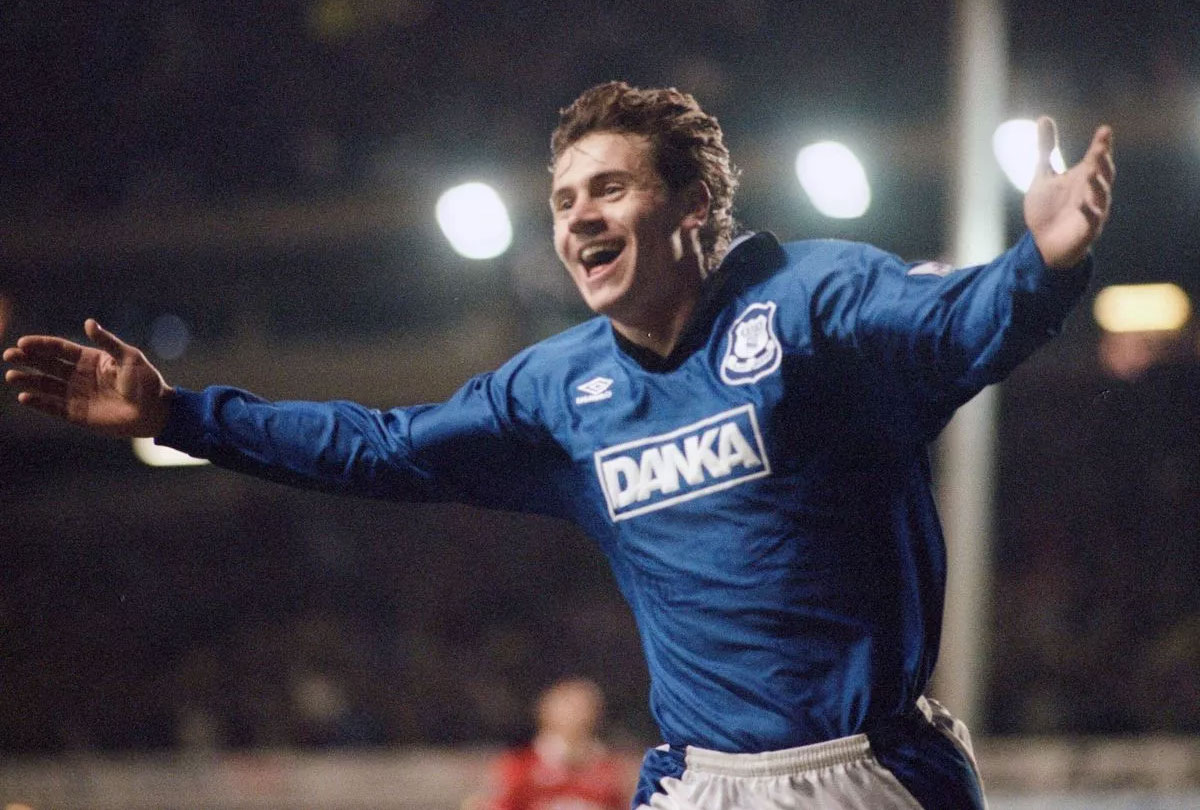
In the summer of 1995, following Everton's FA Cup success and with renewed spending power under Peter Johnson, it felt as though the Club was on the cusp of something special. The Blues went toe-to-toe with Liverpool for the signing of Stan Collymore from Nottingham Forest but lost out when the Reds captured him for £8.5m. However, Johnson landed a considerable coup later in the transfer window with the acquisition of Andrei Kanchelskis from Manchester United for £5.5m.
The flying Ukrainian winger had to wait to make his debut because of a contractual dispute with United and he then disclocated a shoulder — to add insult to the injury, he suffered it playing against United — but when he finally introduced himself properly to Blues fans later in the 1995/96 season, it was a match made in Heaven.
Kanchelskis scored a brace at Anfield to win the Merseyside derby and went on to fire 16 goals in all that season, including a memorable hat-trick at Sheffield Wednesday, helping to fill the void left by Duncan Ferguson who became the first British Footballer to serve prison time when he was sentenced to six weeks at infamous Barlinnie Prision and also struggled at times with a groin injury during the campaign.
Neverheless, though Royle was unable to build on his cup success of the previous season as Everton were dumped out of the League Cup by Millwall, lost in the European Cup Winners' Cup over two legs to Feyenoord and were beaten in an FA Cup Fourth Round replay by Port Vale, the season was a hugely encouraging one. The Blues came within a whisker of qualifying for the UEFA Cup, pipped to the post on the final day by Arsenal who finished fifth while Everton had to be content with sixth place.
Barry Horne and Daniel Amokachi left Goodison Park over the summer of 1996 but boyhood Evertonian, Gary Speed, was signed from Leeds and Nick Barmby was added later in October to add trickery and further goals. As the halfway point of the season approached, Royle's men were being touted as dark horses for the title. After a downturn in form following the 2-0 opening-day win over Newcastle that saw the Toffees fail to win for six games, they went on to record victories in six of the next 10. Southampton were demolished 7-1 at Goodison and when Barmby's solitary goal secured a win at Derby in mid-December, Everton were in sixth and seemingly upwardly mobile.
However, one of those winters of discontent arrived shortly afterwards, with an injury crisis gripping the squad leading to a collapse in form, confidence and results that would send the Blues into a tailspin down the Premiership table. Six straight defeats were followed in January by another miserable defeat to lower-division opposition in the FA Cup, this time at home to Bradford City and veteran winger Chris Waddle who won 3-2.
That poor performance also proved to be Kanchelskis's swansong. The winger had been noticeably below par for a while and Royle had admitted that he was not "right in the head" as rumours of off-the-field issues surfaced. Soon afterwards, he was sold to Fiorentina for £8m, Everton's fading star winger following Limpar, Samways, Rideout and John Ebbrell out the door.
As the March transfer deadline aproached, Royle was desperate to add bodies to a squad still beset by injuries and struggling to score goals. Chairman Johnson had pledged to spend money on strengthening the squad but he hit an impasse with his manager over a double-deal to sign Norwegian striker Tore Andre Flo and his compatriot, and make-weight in the deal, Claus Eftevaag. Flo was uncomfortable being rushed into a move from SK Brann and Johnson is reputed to have vetoed the Eftevaag transfer, so instead of much-needed new blood, the transfer window ended with Royle parting ways with Everton.
It was a sad end to a tenure that promised so much after the spectacular high of the FA Cup win in May 1995 but it was also a portent of the difficulties to come under Johnson that would lead to another brush with relegation in 1998. Dave Watson managed to steer the Blues to safety in the final weeks of the 1996/97 season as caretaker boss, membership of the top flight assured with a game to spare and by the time the new campaign kicked off in August, another very familiar face was in the dugout at Goodison Park.