

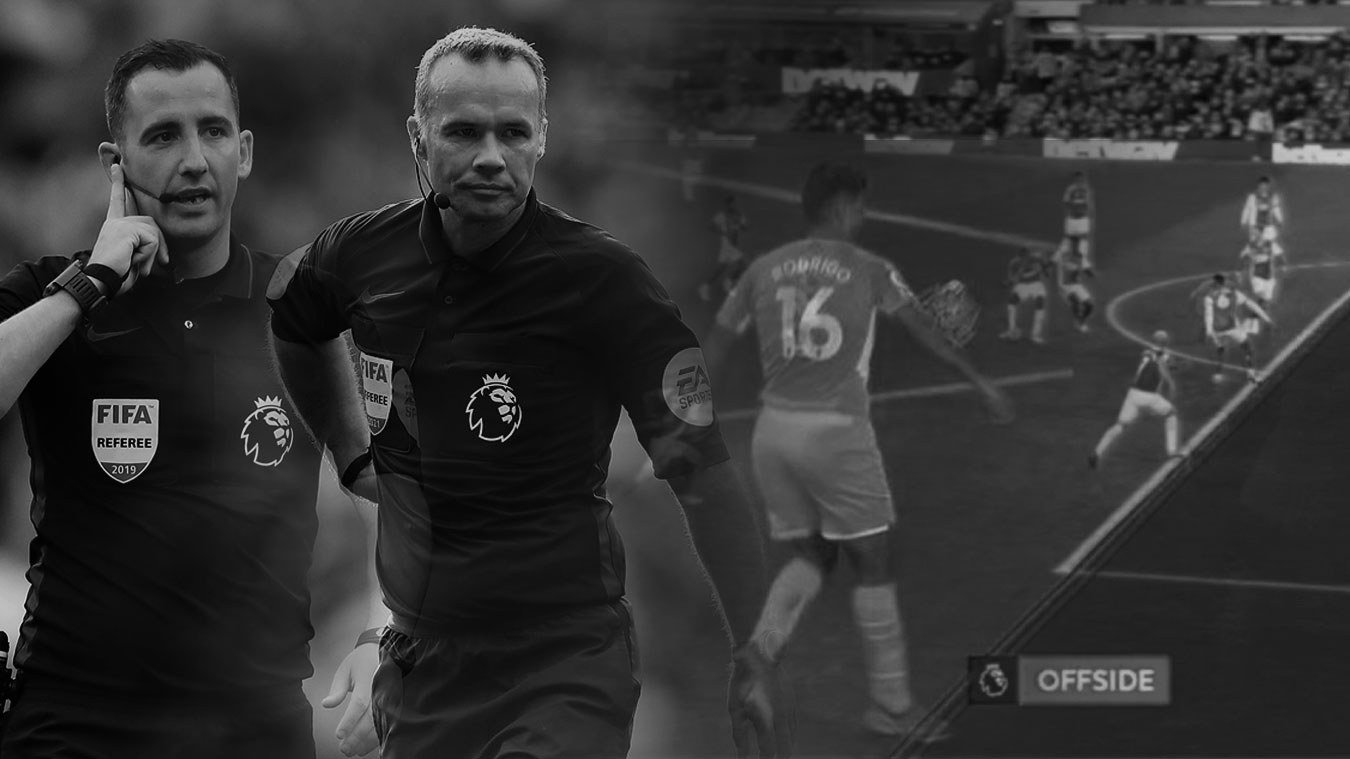
This Just isn't Football
The spirit of the game is being eroded by meddling and incompetence amid poor implementation of supposed "technological advancements"
Another weekend, yet more VAR controversy in the Premier League and, of course, in the Carabao Cup Final. A Wembley showpiece event and an important League match involving the potential title winners, where the main discussion after the fact is not on the quality of the football but on baffling, hair's-breadth decisions made using arbitrary lines on a computer screen, the increasingly maddening interpretation of handball, and the ludicrously high bar for what constitutes “clear and obvious” or sufficient doubt to make what should be simple decisions. That would be if the spirit of the game is the guiding principle.
Sadly, it's not and hasn't been for a long time but even the rationale for introducing Video Assistant Referees to top-level football in the first place hasn't been met. Rather than eliminate the protracted debates and examination of controversial incidents on telestrators by pundits in the Sky and BT Sport studios, the forensic analysis and millimetre-by-millimetre measurements has moved to Stockley Park. There, unaccountable — and seemingly unsack-able — referees with enough doubt over their competence already amassed from their errors on the pitch, make decisions on important matches that directly affect a multi-billion pound industry — decisions that aren't communicated effectively to the spectators.
Everyone wants the correct decisions to be made during football matches — it's why supposedly impartial arbiters in the form of referees and their assistants were introduced to the game in the first place. Somewhere along the line, as the Premier League grew in importance and the quality of television pictures and slow-motion improved, we lost faith in those officials, with technology seen as the eventual solution. We've also taken the responsibility for the final decision out of the hands of the man in the middle, another critical failing of VAR.
As a means of determining whether a goal has actually been scored or not, goal-line camera technology that can detect whether or not the ball has crossed the line has clearly been an unqualified success. That's because it's simple and not open to any subjective interpretation.
Unfortunately, because of video frame-rates and which precise moment a ball is deemed to have left an attacker's foot, the Hawkeye technology as it is currently used for offside is not as black or white. Everything else, from handball to the severity of a tackle is purely subjective and it always will be. That's not to say, however, that it can't be more fairly applied as opposed to them being viewed increasingly, as it appears officials are now doing, through a tech-like prism where the VAR is measuring sleeves and the like.
There's “handball!” when a partisan crowd suspects an infringement and might not be sure but calls it anyway, as fans do. Then there's “HANDBALL!” where the entire crowd in that area of the ground and the players alike all scream in unison at what is clearly and unequivocally a contravention of the rules.
Paul Tierney, the on-pitch referee for Everton's home game against Manchester City on Saturday, may not have had full sight of the incident when Rodri handled the ball in his own box but the Video Assistant Referee, if he were fulfilling his duty with any competence, should have had a quick decision to make.
Instead — we'll set aside accusations of bias from a referee from Greater Manchester whose brother is rumoured to be a Man City season-ticket holder but PGMOL (Professional Game Match Officials) really don't help themselves in this regard — it appears as though Chris Kavanagh deliberated over two stills of the ball making contact with Rodri's arm: one (on the left in the below image) where there is “an element of doubt” because the player is leaning into the ball and one (on the right) where there clearly isn't.
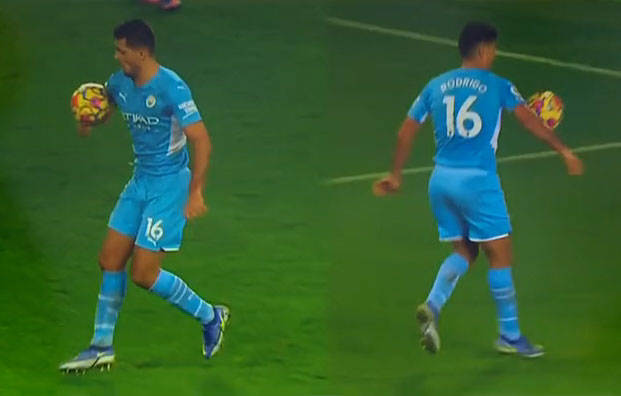
Kavanagh shouldn't have needed to — the right-hand image shouldn't leave anyone in any doubt — but if he had used the video replay instead, he would clearly see that Rodri moved his arm forward, in an unnatural way away from his body and made contact with his arm in order to gain an unfair advantage with an illegal part of the body. In the spirit of the game, Kavanagh and Tierney should have ensured that everything that could have been done to make the correct decision was done but, instead, it looks like little more than a cursory look was taken.
The rules around handball have changed so much and so frequently in the very recent past that no one really knows what the rules are anymore but the change to include the shoulder above the delineation of a short-sleeved jersey as being legal was for accidental contact, particularly at set-pieces. Had Rodri dipped his body in attempt to control the ball with his shoulder, then it's a more muddy incident but he very clearly uses his arm slightly above the elbow.
It was a stonewall penalty and enough to prompt a formal complaint from Everton which resulted in a personal apology from PGMOL head, Mike Riley. However, like the admission by the Premier League of the error made around the penalty given against the Blues at Brighton in October 2019, it means very little. Everton won't get the chance to earn a priceless point. There is no real recourse other than to hope that things get better and the fact that Kavanagh hasn't even been given a cursory one-week suspension shows that there are no real repercussions here.
The offside law was only ever introduced to prevent teams from sticking a goalhanger in the opponent's penalty area. It was never intended to be so black and white that a person zooming in on a screen has to place lines on the edge of an attacker's stud or arbitrarily decide where his armpit is in relation to the heel of a defender's boot. Judging someone to be offside practically by his toenail is as far from the spirit of the game as you can get.
And yet that's where we are with football's search for 100% accuracy when it comes to offside. It's just not football and it's robbing the game of its spontaneity and penalising attacking players for the very fact that their positive desire to score a goal — you know, the very essence of the sport — means they will be leaning forward past the body of a defender whose posture is necessarily the opposite.
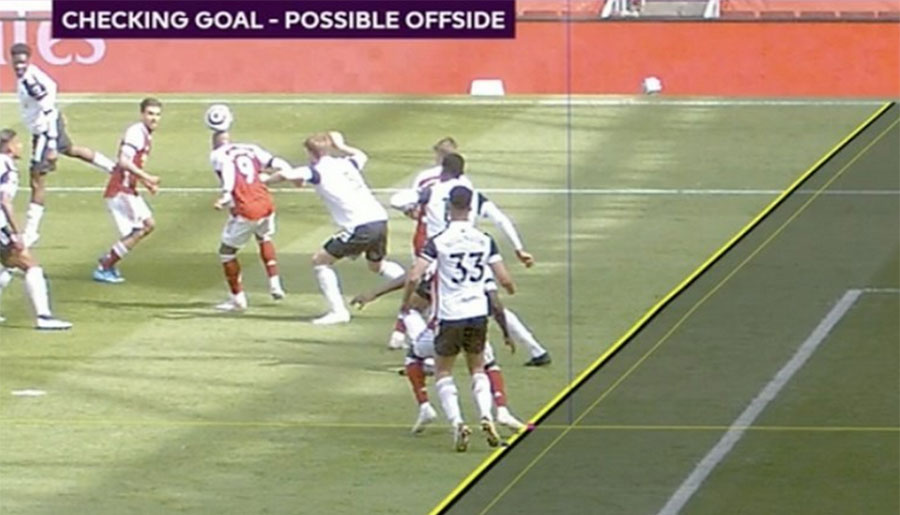
This goal for Arsenal vs Fulham was ruled out even though the attacker's body is well behind the last defender and only his out-stretched toe is beyond the planted foot of the defender. A thicker line and greater margin for error wouldn't have robbed the striker of a goal.
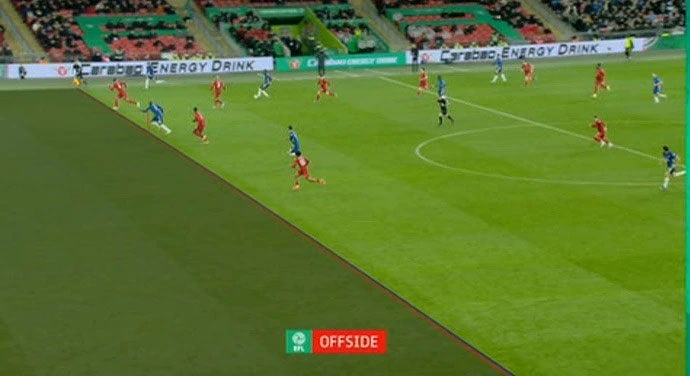
Against Liverpool in the Carabao Cup Final, Lukaku is deemed offside because the measurement is taken from where a short sleeve would end on his jersey, an arbitrary and somewhat ludicrous delineation given that he is clearly level by any sane assessment.
The law was changed so that an attacking player who was level with the last defender was deemed offside precisely to give the benefit of the doubt to the striker (again, in the spirit of the game), allow for more goals and, therefore, a more exciting spectacle. That has now been lost with the obsession with technology. It has been promised that the new semi-automated VAR tech for offside will improve things but it's hard to see how, given that it will be calibrated to the same minute margins as we currently have.
Indeed, those margins are calibrated using a specifiic frame in the video sequence but as the passing player's foot goes through the motion of playing the ball, there are several frames that could be chosen as the origin of the pass and which one is selected affects the placement of the line for the receiving player.
The configuration of the Hawkeye cameras means that the “daylight” concept for offside, where there is a clear separation of the torsos between opposition players, apparently won't work but there is clearly scope for restricting decisions to the players' feet and expanding the margin of error to two thick lines — much thicker than the ones currently in use.
If there is any overlap between those two lines, it is onside. That way, the rule stays within the original parameters of offside — ie, to prevent teams from gaining an unfair advantage by placing a player well beyond the last defender, especially if, as Romelu Lukaku was against Liverpool in Sunday's League Cup Final, the forward is 35 yards from goal!
Under those conditions, Richarlison isn't robbed of a goal against Arsenal at Goodison earlier this season from an instance where he is level with the defender under any fair interpretation of the original rules, Everton have a goal and the League has a more exciting contest for what was a national and international domestic audience.
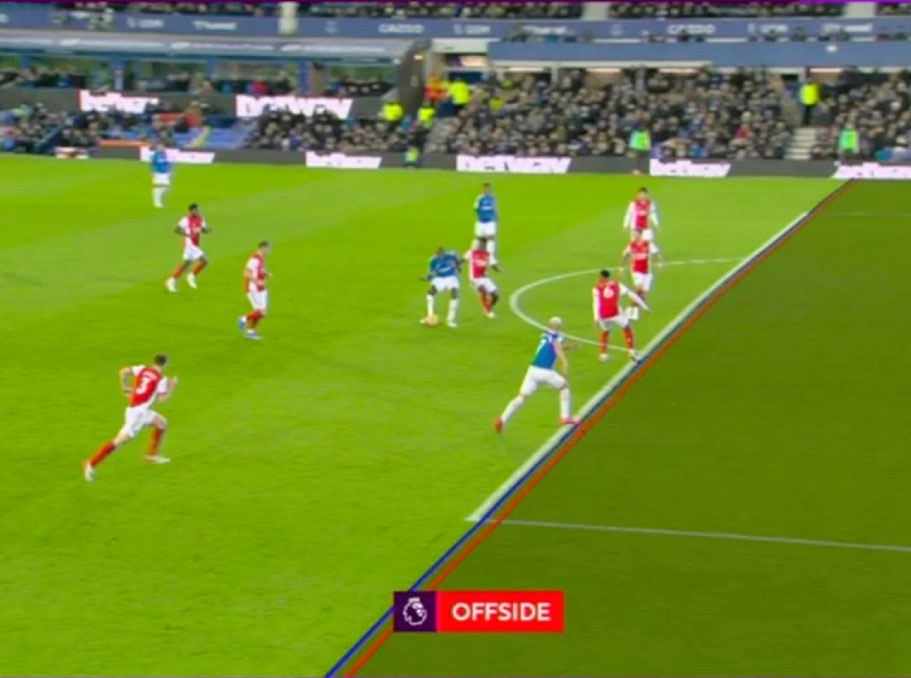
Richarlison is level and onside within the parameters of the spirit of both the game and the original intent of the offside law
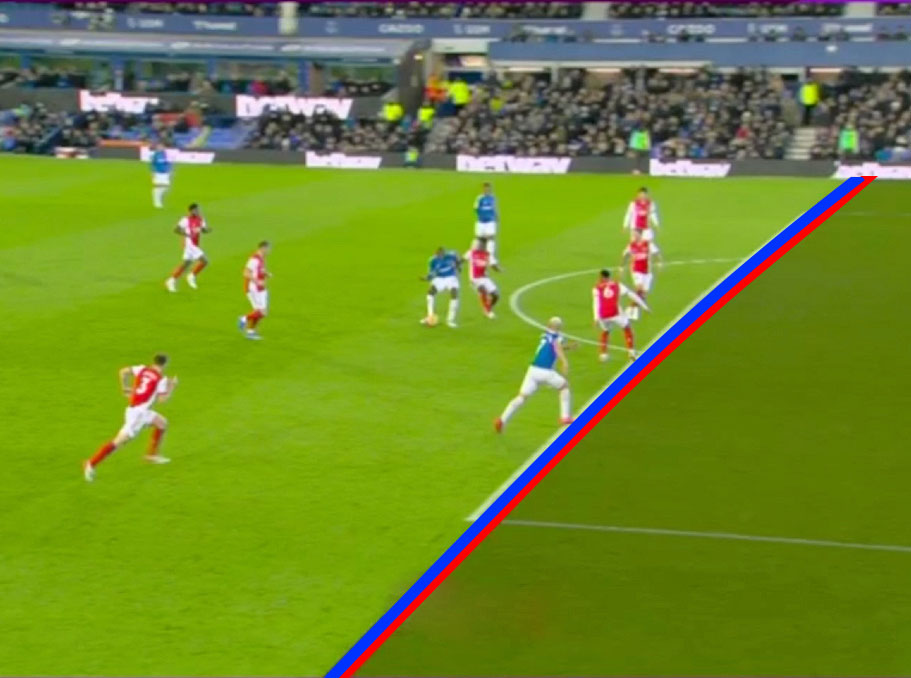
Widening the lines to increase the margin for error would be both technically feasible and would grant the attacker much more leeway in these ridiculously tight situations. Here, the lines overlap so Richarlison would have been deemed to be onside.
In an era when the elation of a goal for your team — particularly a meaningful one scored very late on, arguably one of the most thrilling moments in football — is being significantly tempered by the fear that a hairline offside decision or subjective and debatable handball decision could rob you of it, it's hard not to feel as though the game's decision-makers have let their obsession with technology and the quest for accuracy go too far, particularly where accuracy can never be guaranteed.
It's worse in England, of course. On the Continent, VAR appears to have been implemented much more successfully, offering proof that with a bit more common sense and appreciation for the spirit of the beautiful game, the tech doesn't have to be a problem.
There will always be contentious moments and decisions that are obviously wrong; that's unavoidable when human beings are involved. The key, of course, is to reduce those to a minimum while also establishing rules and guidelines where fans feel like it's the sport that has been placed at the forefront rather than technology. We've got a long way to go.
Reader Responses
Selected thoughts from readersEither no responses have been submitted so far to this article or previous submissions are being assessed for inclusion.
Add Your Thoughts
Only registered users of Evertonia can participate in discussions.
Or Join as Evertonia Member — it takes just a few minutes and will allow you to post your thoughts on artices across the site.