

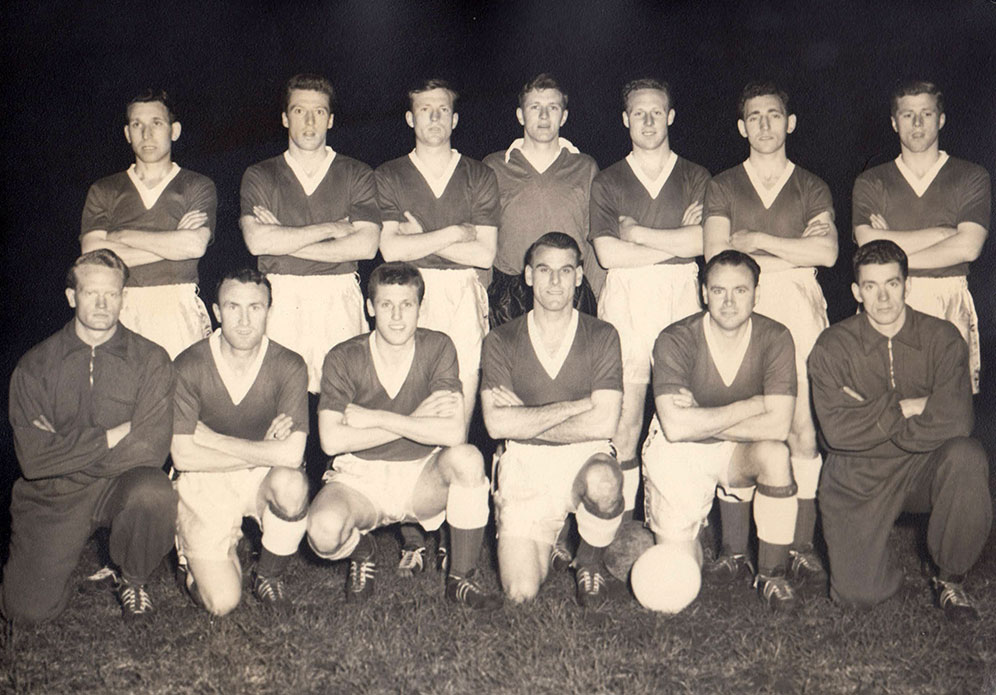
The Toffees in North America – 70 Years Ago
Recounting Everton's trip to the United States and Canada in the mid-1950s where they played a series of exhibition matches to help raise the profile of soccer in the continent
70 years ago, the Toffees were in the middle of a post-season tour which had only been bettered for ambition by the 1909 voyage to Argentina and Uruguay.
The May to June 1956 tour would be in the USA and Canada, encompassing a series of exhibition matches against local, German and Scottish opposition, to help raise the profile of soccer in the continent, and swell the Blues’ coffers. Mention of a possible tour across the Atlantic was first made in the club’s board minutes in September 1954, when it ‘was agreed to explore the possibilities of a Tour to the USA next summer.’ In fact, it would be 18 months before the travelling party met at Lime Street Station on the first leg of their journey. By that time, the club was managerless as Cliff Britton had become a casualty of the tour planning.
The former Toffees and England wing-half, who had taken the reins of first team affairs in 1948, had taken umbrage at the board appointing Harold Pickering as acting manager, back in England, while Britton and the team would be spending in the region of six weeks abroad. Britton had not been consulted on this and was incandescent at what was a ‘land grab’ by some directors. He promptly quit, with a messy divorce ensuing.
The board, intent on asserting more control over team affairs, decided to appoint a Chief Coach, with less powers than Britton had enjoyed as General Manager. The successful candidate, Ian Buchan (a Scottish physical training expert), would not be available in time to join the traveling party, so it was left to several directors, club secretary Bill Dickinson plus trainer Charlie Leyfield to oversee the 16 players on the tour.
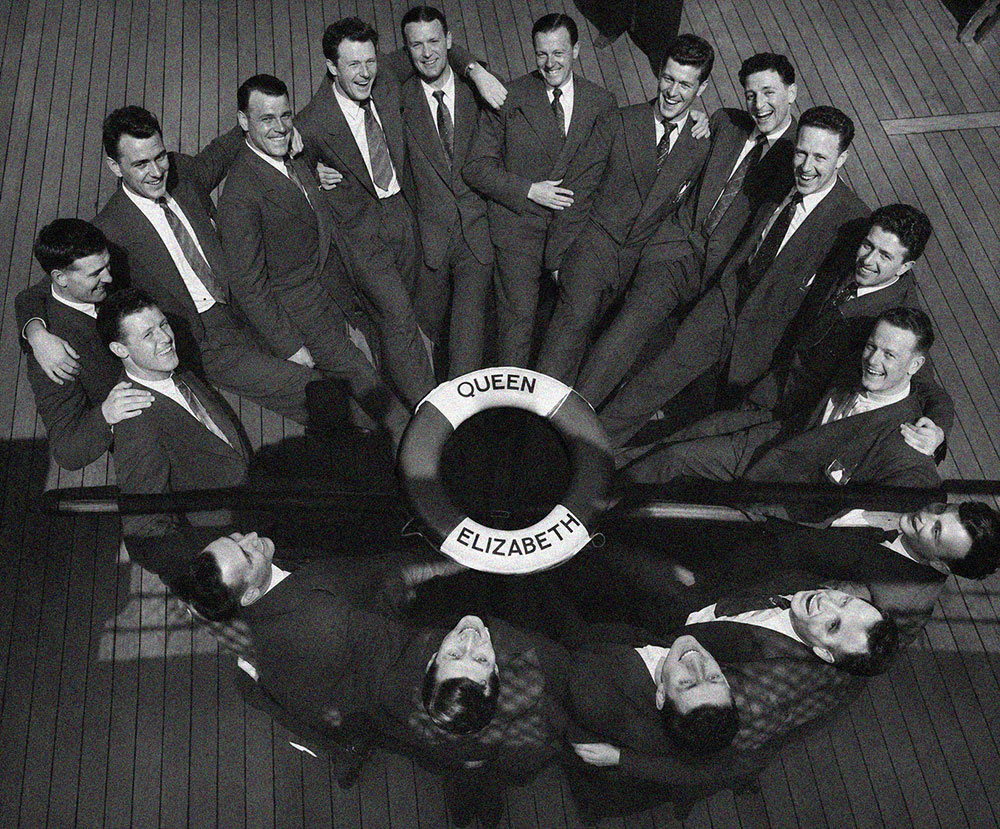
On the Queen Elizabeth, sailing to New York
The Everton party travelled by train to Southampton before embarking on Cunard’s Queen Elizabeth ocean liner, in anticipation of a six-day voyage to New York. Mercifully, the weather was kind and there were few incidents of sea sickness. Director Ernest Green asked club captain Peter Farrell to keep an eye on his teammates. Every morning there was a training session on deck, which Green would watch, complimenting the lads on appearing fit and sharp. He was not wise to the fact that most of the lads hadn’t been to bed and were feeling the worse for wear.
Disembarking in the Big Apple, the tour party was welcomed by representatives of the American Soccer League and, the following day, met Newark’s mayor Leo P. Carlin. The trip to his office was made in seven cars, with a smooth passage through downtown being assured by the shrieking sirens of the police motorcycle escort. They were also welcomed to a banquet at the Newark Portuguese club.
The ten-match programme began on 18 May in Newark, New Jersey, with a fixture against a local Portuguese–Polish XI. The match preview in one local newspaper described the Blues as the ‘Everton booters’. This routine 4-0 win (Don Donovan netting three times) watched by 2,000 people was notable for being played under floodlights – a novelty for British teams (Goodison Park would have floodlights installed in 1957). Next up was a thumping 7–0 defeat of an American Soccer League XI at Randalls Island, New York; this time it was young striker Jimmy Harris who notched a hat-trick. The ASL goalkeeper, Orlando Jorge, was impressed by the touring side:‘I have never seen anything that compares with that team. They’re great. Everton players are in perfect condition. They run, run for 90 minutes. And can they ever handle the ball; their teamwork is perfect. They make short, precision passes. They put the ball right on the other guy’s toe. And they kick it like a cannon shot. When they get in range – brother, can they put it in the corner.’
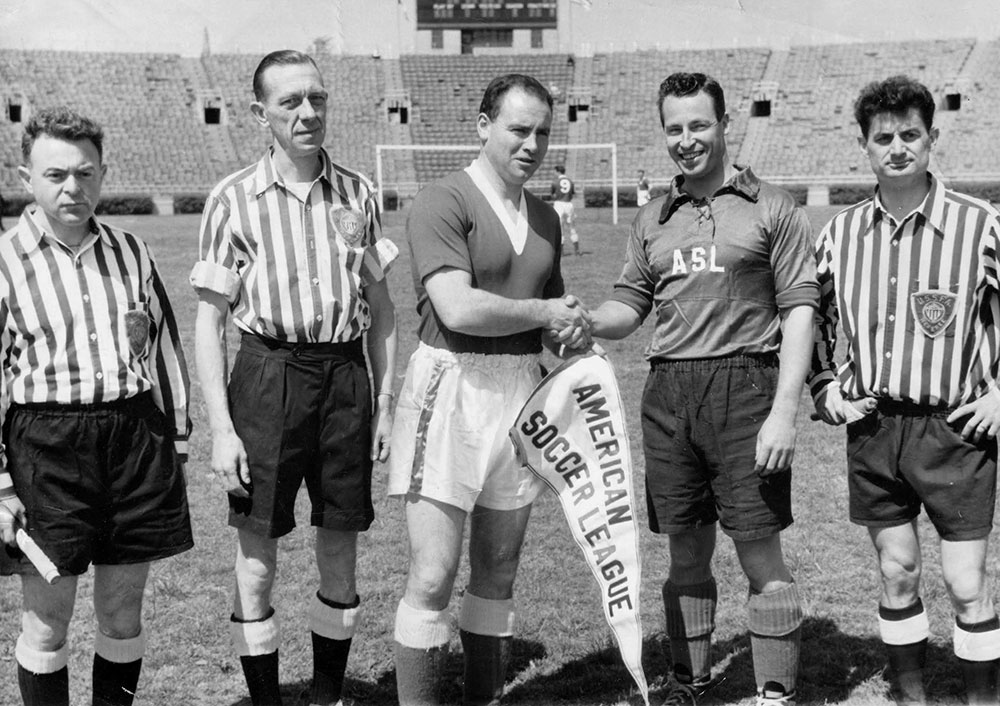
Skipper Peter Farrell takes part in a pre-match pennant exchange
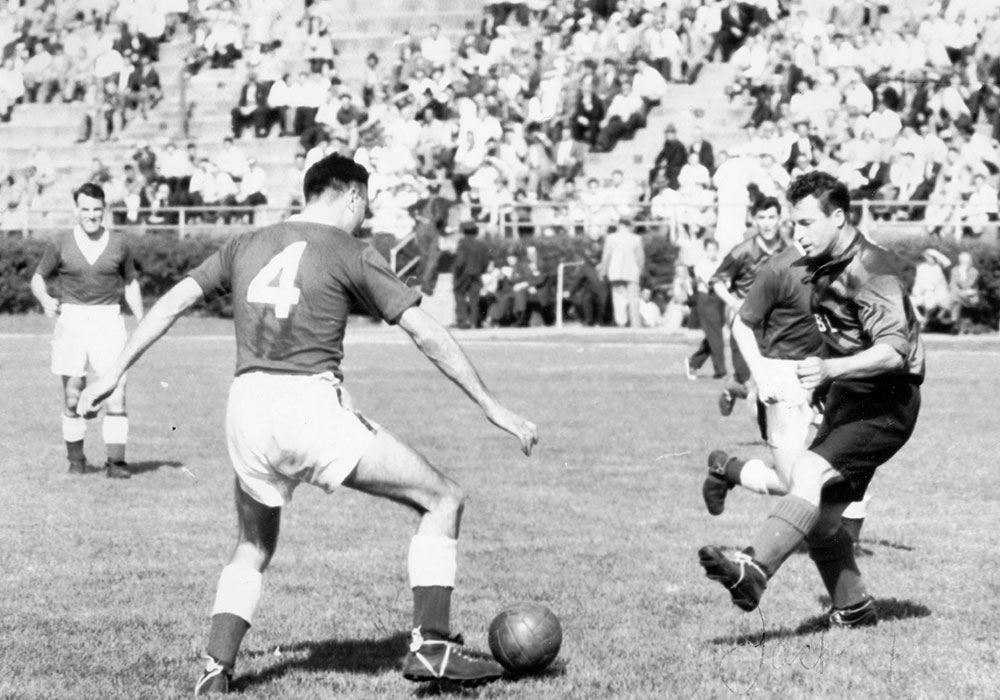
Matt Woods on the ball watched by Cyril Lello
The wins and the goals kept coming. In a subsequent match in Ludlow, Massachusetts, the – perhaps hyperbolic – local newspaper report described the Toffees (4-1 winners) as being ‘as nimble-footed a clan of musclemen as ever appeared on the chewed-up Franklin Park pitch’.
While in New York, the tourists from Liverpool were blown away when shown the city’s stunning sites, and were also given guided tours of a brewery and the Radio City Music Hall. The Blues skipper made the acquaintance of Sam Chedgzoy, the legendary Everton and England outside-right. He had emigrated to North America shortly afterwards and made a home in Canada. Always one to keep tabs on his former club, Chedgzoy had made the trip south to watch a match between the Toffees and Aberdeen. He ended up disappointed, as heavy rain and a waterlogged pitch had forced the match to be rescheduled for 17 June. Nonetheless, Chedgzoy enjoyed the company of the Blues’ players and club officials. He asked Peter Farrell to pass on his regards to Evertonians back home, via the Irishman’s Liverpool Echo column.
The only defeat on the tour was a 0–1 loss to West German side Schwaben Augsburg at the Downing Stadium, New York, on 30 May. The Everton matchday programme report of the tour described the opponents as ‘vigorous and dirty’ in their play. The nearest Everton came to scoring was when Peter Farrell dribbled half the length of the field but hit the post as the German goalkeeper ran out to narrow the angle.
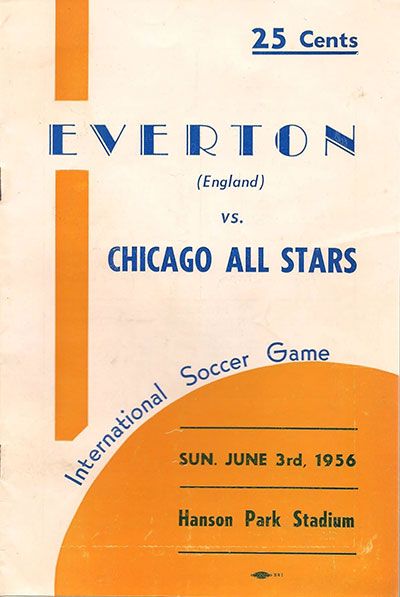
From New York the party flew to St Louis, where Peter, fellow player Jimmy Harris, trainer Charlie Leyfield and club secretary Bill Dickinson appeared on a local television station broadcast, prior to their match with a local Catholic Youth XI (sadly, the interview does not appear to have been preserved for posterity). A train ride then took the Toffeemen to Chicago for their next fixture against Chicago All Stars. At the post-match reception, hat-trick scorer Farrell was puzzled by the effusive praise for his performance until it transpired that Tommy Eglington had made it known to spectators and reporters that Peter was 44, 12 years older than his true age.
Farrell thoroughly enjoyed the tour, which proved to be quite lucrative for the players: ‘The beauty of that was that we were on a four pounds win bonus and the teams weren’t very good!’ In his newspaper column he recounted meeting many exiled Merseysiders – most of whom professed to be missing their regular dose of soccer at either Goodison or Anfield. He also bumped into Canadian player Gordon ‘Gogie’ Stewart, who had spent the 1953/54 season on Merseyside, playing for Everton’s reserve team. Having declined the offer of a further season at Goodison Park, Stewart was now back home and decked out in a ten-gallon black hat and coloured windbreaker to greet his erstwhile comrades.
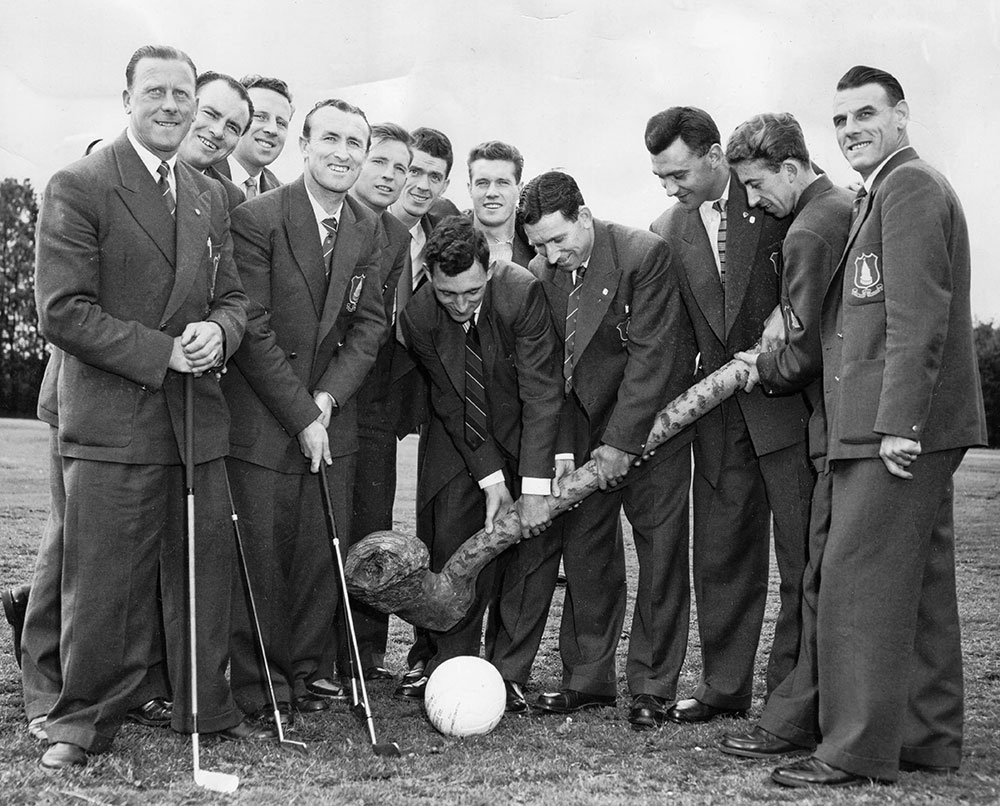
"Golf — of sorts — in British Columbia
The tour wrapped up with four fixtures contested with Aberdeen. The first three were played in Canada: in Vancouver, Edmonton and Toronto. Ironically, in light of the opposition, on touching down at Vancouver Airport, the Everton side was welcomed by four city police and pipers decked in Stuart tartan. The first match, played under lights in the British Columbian city, ended in a 3-3 draw. There was some downtime, with the squad playing golf at Langara and watching horse racing at Lansdowne Park in Richmond. 2-1 and 3-1 defeats of the Dons followed before both teams relocated to New York for the rescheduled match, the final fixture of the grueling schedule. It was worth the wait — an exciting tussle with the Blues emerging victorious, 6-3.
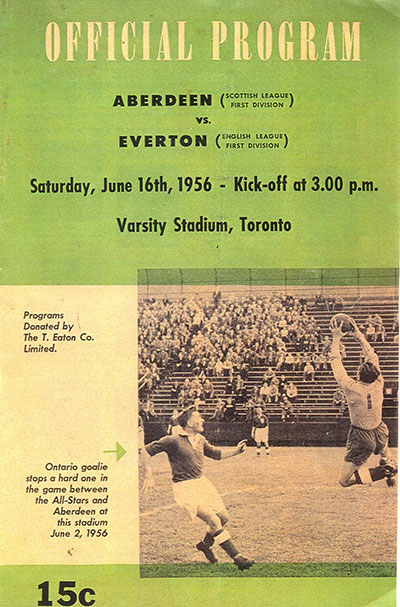
Programme cover from the penultimate match of the tour
The airline BOAC held up the departure of their Boeing Stratocruiser service across the Atlantic as the side dashed to the airport after the match. The aircraft was due to refuel at Prestwick and land at Manchester but was forced by the inclement weather to proceed directly to London.
At London Airport (now Heathrow) the players rushed to change dollars to sterling and phoned their families with the news that they would be late arriving home. An aircraft was then laid on by the airline to get the squad back to Liverpool’s Speke Airport.
Bill Dickinson, who oversaw much of the tour’s logistics, said that it had been ‘very, very successful’. He continued: ‘The United States standard of football is not very high, but the Canadian standard is a little better. Of the native teams we met, the Chicago side were the best of the bunch.’ Director Jack Sharp Jr. added, ‘Soccer tours of Canada and the US are long and tiring, but they’re a grand thing for British Soccer players. Every club in England is eager to make the trip, and rightly so.’
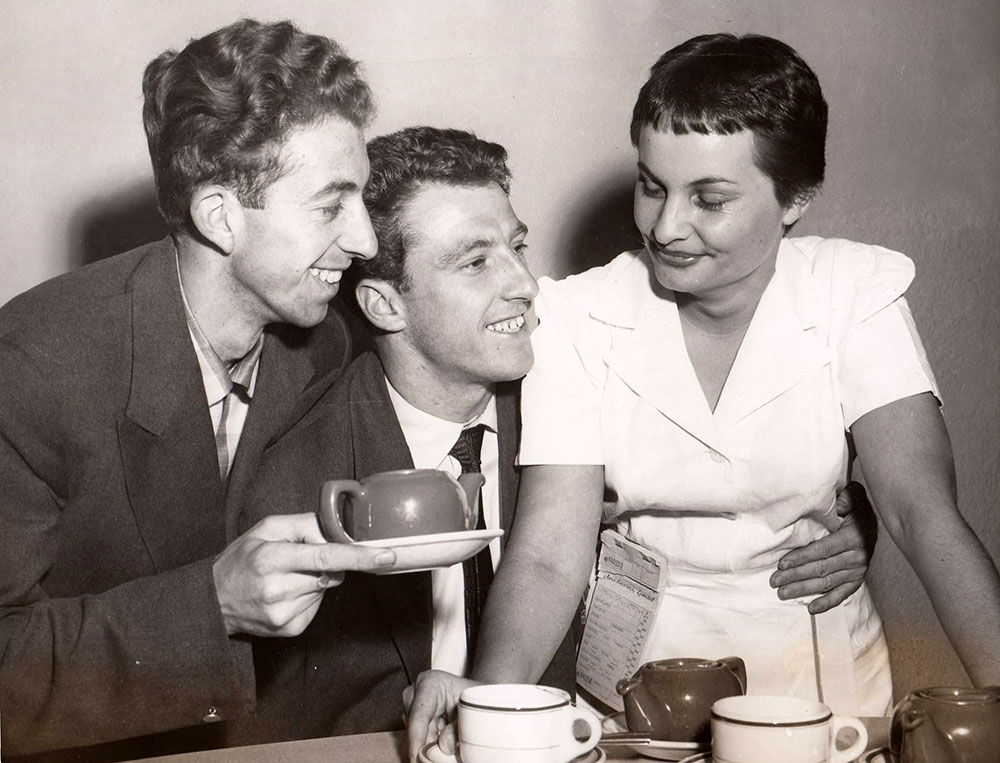
Ken Rea and Jimmy Harris get aquainted with a waitress in North America
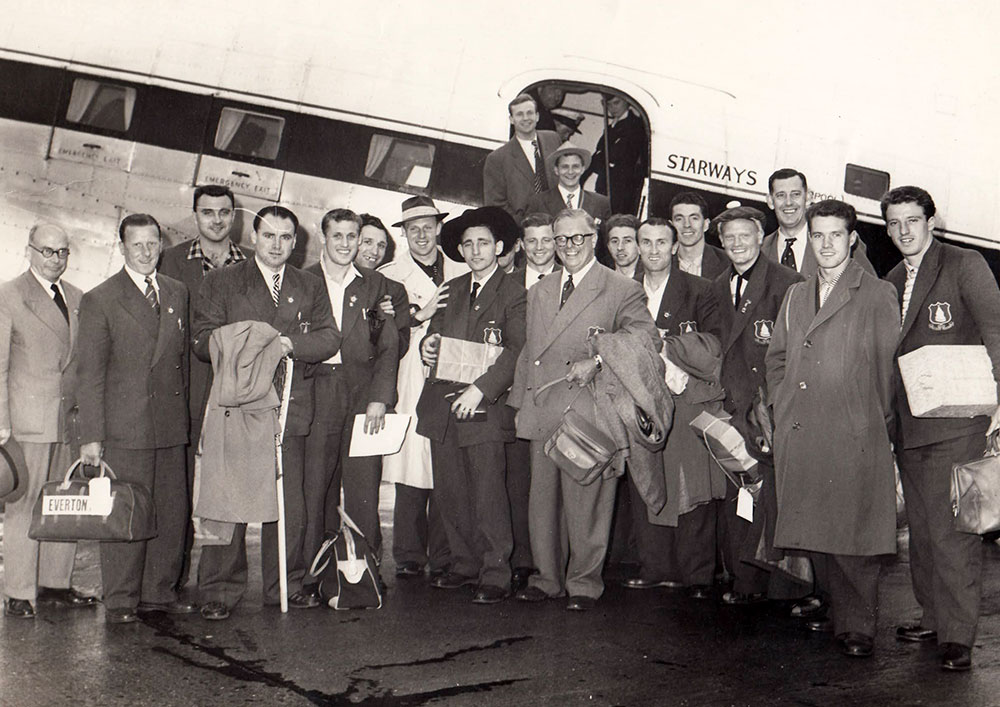
The last flight leg back to Liverpool — and a few souvenirs of the trip are visible
The tour had certainly been enjoyable for the players, enabling them to earn some extra cash, discover the sights and bright lights of two countries and ease to victories on the pitch, in most cases. It had also given playing time to fringe players and young pros like Ken Rea and Ken Birch. The side had left a favourable impression on North Americans, with a number writing to Liverpool newspapers to express their appreciation. One correspondent, Mr. Eric Sutcliffe of Alberta, formerly of West Kirby, wrote: ‘They were wonderful ambassadors for Britain and I hope we shall see them again.’
Everton would return to North America in 1961 for the International Soccer League tournament, but new manager Harry Catterick was unhappy with the disruption it caused to preparations for the 1961/62 season. A fleeting stopover in Hawaii, on the way back from Australia in 1964, was the Toffees' next, brief, taste of the USA. It would be 1985 before Everton crossed the Pond again, the league champions participating in the Molson Canadian International Series in Toronto.
Further reading:
Toffee Soccer: Everton and North America – David France, Rob Sawyer, Darren Griffiths (deCoubertin books)
The Emerald Evertonian: The Peter Farrell Story – Rob Sawyer (Toffeeopolis/Mount Vernon)
Other sources:
efcstatto.com
bluecorrespondent.co.uk
evertoncollection.org.uk
The Farrell family
The family of Jimmy Harris
The family of Matt Woods
Andy Weir
Reader Responses
Selected thoughts from readers12/06/2026 20:16:50
Really enjoyed this article! Many thanks! My formative years were spent living at No.46 Wallace Drive in Huyton. Living a few houses on the other side was Tommy E. Jones. My dad was very friendly with Tommy. All the houses were semi-detached and later on in the early sixties, Mick Meagan was the Jones' neighbour! When Mick Meagan was part of the swap deal for the legendary Ray Wilson all us kids were waiting for Ray to be our new neighbour. Alas, it never happened. Tommy has three boys and a daughter. All three boys were good footballers! In my fading memory, I have a feeling of seeing Tommy's USA trip photo album!
Add Your Thoughts
Only registered users of Evertonia can participate in discussions.
Or Join as Evertonia Member — it takes just a few minutes and will allow you to post your thoughts on artices across the site.
08/06/2026 16:09:43
Thanks Rob, these stories are great. I really enjoy these early pioneering trips which must have been so exciting for the players with the added incentive off a four quid win bonus!